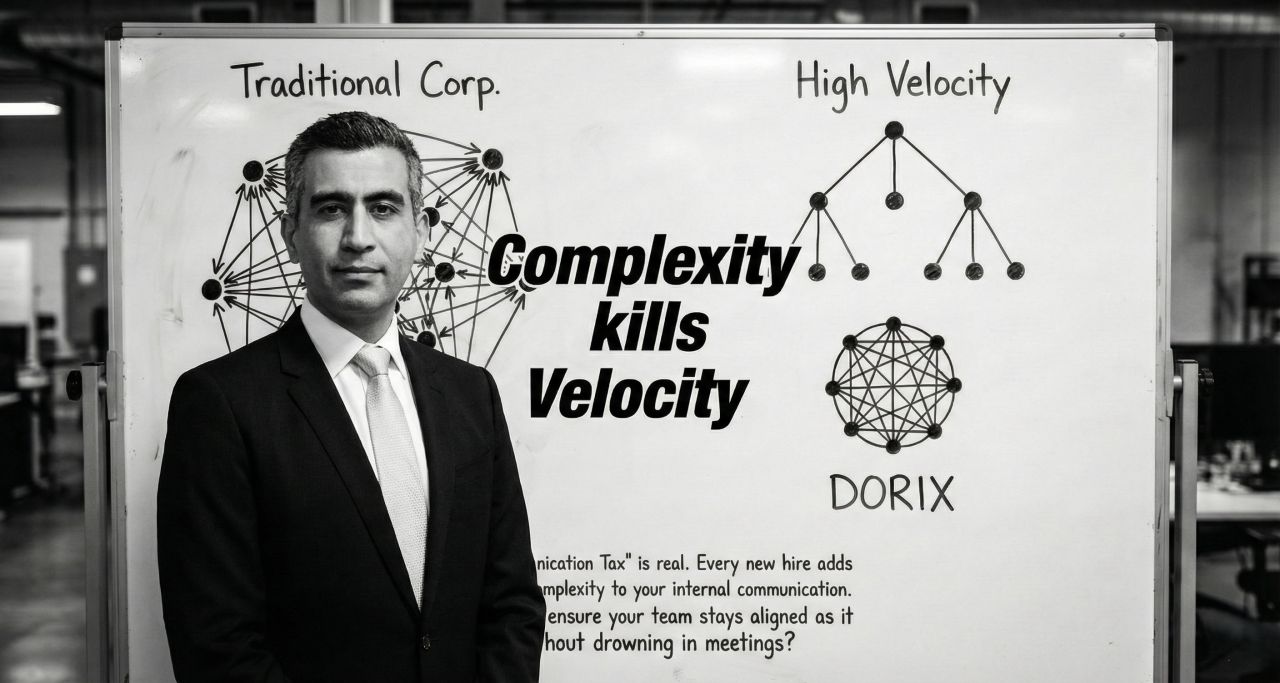
There is a law in physics that applies directly to business: as mass increases, velocity decreases.
Most leaders confuse “growth” with “bloat”. They believe that to double their revenue, they must double their headcount.
This is a fallacy.
When you add a new person to a team, you are not just adding a resource. You are adding a “communication node.” You are adding latency to every decision.
At DORIX, we operate on a principle of Zero-Latency Leadership.
We keep our structure deliberately lean not to save money, but to save time.
Here is the operational rule we follow: The distance between the problem and the decision-maker must never exceed one degree.
If a problem has to pass through a manager, then a director, then a VP to get a “yes,” the company is already dead. It just doesn’t know it yet.
We hire what I call “Autonomous Architects.” These are people who do not need to be managed; they only need to be aligned.
The lesson for 2026:
Do not hire to fix a broken process. Fix the process first. Then hire the person who can run it without you.
Scale your output, not your complexity.